US responds to Modi's 'ghar mein ghus kar...' remark, Pannun assassination plot
Web Desk
- {{topics.sectionTitle}}
- {{item.tagTitle}}
HOT AND HAPPENING

Video: 'Surya Tilak' lights up Ram Lalla’s forehead at Ayodhya Ram Mandir
The spectacle was created using an elaborate mechanism involving mirrors and lens
Web Desk
April 17, 2024


Airport art: Who would stop and stare?
What is the end goal of having airports impeccably curated with art works?
Vidya Balan in candid conversation on "Do Aur Do Pyaar" | THE WEEK
Powerhouse Vidya Balan in a candid conversation on her forthcoming film, the keenly awaited musical romantic comedy, "Do Aur Do Pyaar" (releasing on 19th April), co-starring Pratik Gandhi, Ileana D'Cruz and Sendhil Ramamurthy.
-
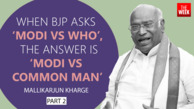
Exclusive interview with Congress President Mallikarjun Kharge | INC | Part 2 | THE WEEK
Mallikarjun Kharge is facing his toughest challenge since he became Congress president in October 2022. THE WEEK caught up with Kharge for a detailed interview where he talks about Prime Minister Narendra Modi, electoral bonds and the Ram Temple
-

Exclusive interview with Congress President Mallikarjun Kharge | INC | Part 1 | THE WEEK
THE WEEK caught up with Mallikarjun Kharge for a detailed interview where he talks about Prime Minister Narendra Modi, election guarantees, and the challenges the Congress party is encountering in the upcoming elections.
-

Interview with former IAS officer and Congress candidate Sasikanth Senthil | THE WEEK
Former IAS officer Sasikanth Senthil is all set to contest Lok Sabha polls from Tamil Nadu's Tiruvallur. THE WEEK caught up with the Congress candidate for a quick interview where he talks about his campaign and the Congress manifesto
International
- EU leaders wanted to talk competitiveness. Middle East tensions and Ukraine top their summit list
- Envoy says US and allies are mulling options 'both inside and outside the UN' to monitor North Korea
- Aung San Suu Kyi has been moved from prison to house arrest due to heat wave Myanmar military says - A
- Important Advisory
- Italy seeks G7 message to de-escalate Mideast tensions as foreign ministers meet in Capri
Entertainment
- Rasika Dugal-Arjun Mathur’s ‘Lord Curzon Ki Haveli’ to close UK Asian Film Festival
- Salman firing case Original Aadhaar cards bike documents helped cops to identify suspects
- Amitabh Bachchan to receive Lata Deenanath Mangeshkar Puraskar
- Duo conducted recce around Salman's house 3 times before firing Police hired by Bishnoi gang
- Maharashtra CM visits Salman's house asks police to increase security for actor and kin
Sports
- Para-archer Sheetal claims silver in competition with able-bodied at Khelo India National meet
- Zheng eases past Cîrstea in Stuttgart opener after long trip from China. Mertens to play Swiatek
- Faltering Punjab Kings Mumbai Indians desperate to resurrect IPL campaign
- WI skipper Powell trying to convince Narine to come out of retirement ahead of T20 World Cup
- Guys like Kohli Dhoni keep believing and that is what I tried to do Buttler after record run chase
Business
- Stock market today Asian benchmarks are mixed while US seems committed to current rates
- India not reaping benefits of demographic dividend Raghuram Rajan
- Ahead of FPO Vodafone Idea garners Rs 5 400 cr from anchor investors
- Ahead of FPO Vodafone Idea garners Rs 5 400 cr from anchor investors
- Indian economy projected to grow 6.5 per cent in 2024 UNCTAD
The clip shows the actor in a never-before-seen avatar, with dreadlocks

EDITOR'S PICK
Challenges galore as Congress fights for survival
Lack of money and fissures within the opposition are hurting the party
By Soni Mishra
'All anti-people laws by BJP will be reviewed': Chidambaram
Chidambaram is Congress's manifesto maestro
By Soni Mishra
'BJP wants to manipulate the election': K.C. Venugopal
We are living in a dark era
By K.C. Venugopal
'When BJP asks Modi vs Who, the answer is Modi vs Common Man': Mallikarjun Kharge
Kharge is facing his toughest challenge since becoming the Congress president
By Soni Mishra, Midhun M. Kuriakose and V.S. Jayaschandran/Bengaluru
Kejriwal's political voyage has come to a full circle
Will Kejriwal emerge stronger from his imprisonment, is the question
By Soni Mishra and Mohit Sharma
The OnePlus Nord CE4: Evaluating battery longevity and software seamlessness
Camera performance is generally okay, but lacks in low-light shots
By Manik K
{{gallery.albumList[0].albumTitle}}
{{item.galleryDescription}}
-
Knee Support & Beyond A Holistic Approach for Healthy Joints!
-
Watch Full~ "Arcadian" (2024) (FuLLMovie) Online for Free!
-
Ultra Air Cooler Reviews (Buyers Beware!) Read It First Before Buy
-
Quantum AI Review 2024: Scam or Legit? - Crypto Expert's Opinions!
-
Immediate Serax Review 2024: Scam or Legit Crypto Platform? - Fact-Check